
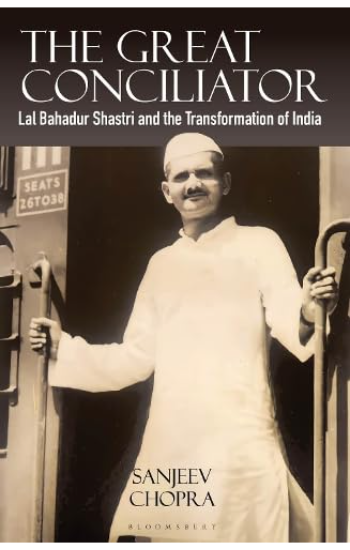
The Great Conciliator: Lal Bahadur Shastri and the Transformation of India
Publisher:
| Author:
| Language:
| Format:
Publisher:
Author:
Language:
Format:
₹899 Original price was: ₹899.₹674Current price is: ₹674.
In stock
Ships within:
In stock
ISBN:
Page Extent:
Lal Bahadur Shastri, a man of slight stature, took a larger-than-life stand as India’s prime minister. A man of few words, his correspondence was to the point, his speeches succinct. His silence, which some understood as willingness to acquiesce, was both a strength and a weakness. But in fact, during his short term of just about eighteen months, he established institutions that brought India on the path of self-sufficiency and helped defend against external aggression.
Prime Minister Shastri galvanized the nation with his slogan ‘Jai Jawan, Jai Kisan’, recognizing the farmers for contributing to both food and national security. He is credited with laying the foundation of the Green Revolution, providing an institutional format to the Commission for Agricultural Costs and Prices and the Food Corporation of India, and establishing the National Dairy Development Board.
Shastri is also strongly etched in public memory as the first Indian prime minister to direct the army to cross the border. To his leadership therefore goes the credit for the first ‘surgical strike’. He established key national and domestic security organizations like the Border Security Force and the Central Bureau of Investigation.
In The Great Conciliator, Sanjeev Chopra draws on meticulous research to turn the spotlight on an often overlooked figure in Indian politics and makes a case for reassessing the legacy of India’s unassuming second prime minister.
Reviews
Lal Bahadur Shastri, a man of slight stature, took a larger-than-life stand as India’s prime minister. A man of few words, his correspondence was to the point, his speeches succinct. His silence, which some understood as willingness to acquiesce, was both a strength and a weakness. But in fact, during his short term of just about eighteen months, he established institutions that brought India on the path of self-sufficiency and helped defend against external aggression.
Prime Minister Shastri galvanized the nation with his slogan ‘Jai Jawan, Jai Kisan’, recognizing the farmers for contributing to both food and national security. He is credited with laying the foundation of the Green Revolution, providing an institutional format to the Commission for Agricultural Costs and Prices and the Food Corporation of India, and establishing the National Dairy Development Board.
Shastri is also strongly etched in public memory as the first Indian prime minister to direct the army to cross the border. To his leadership therefore goes the credit for the first ‘surgical strike’. He established key national and domestic security organizations like the Border Security Force and the Central Bureau of Investigation.
In The Great Conciliator, Sanjeev Chopra draws on meticulous research to turn the spotlight on an often overlooked figure in Indian politics and makes a case for reassessing the legacy of India’s unassuming second prime minister.
About Author
Reviews

Arun Kumar –
Exposing the Distorted Narrative: A Book That Hides the Truth
I am truly disappointed with this book, particularly in Chapters 34 and 45, as some crucial points are missing:
On a call with his family, Shastri mentioned bringing good news, suggesting people would forget everything after that. Before that, in Kolkata’s Red Road, he unveiled Netaji’s statue, which could have been done on January 23. Perhaps he had planned to bring him back on that day.
Shastri allegedly pointed to the water he drank, indicating something was wrong.
A slip was found in his spectacle pouch, with the note: “Hamaare saath dhoka hua hai” (I’ve been deceived; I will never meet you again).
Despite an offer for a postmortem from the USSR, our government rejected it, even though samples were taken. Some claim there were suspicious marks, like a hole in the back of his head.
Come on almost everyone knows who was behind this Britishers and TN Kaul and in Hiding this matter KGB and GOI.
It feels like half-researched work being sold for money, to change the narrative, and to hide the truth. It’s sad to see that Bloomsbury Publishing, a British publisher, is involved in this. The British think they’re still smart and intelligent, but that’s far from true—then and now, they’re bloody fools who think they can fool everyone else. Don’t try to rewrite history—people have already woken up.
I’ll be returning the book.

Arun Kumar –
Exposing the Distorted Narrative: A Book That Hides the Truth
I am truly disappointed with this book, particularly in Chapters 34 and 45, as some crucial points are missing:
On a call with his family, Shastri mentioned bringing good news, suggesting people would forget everything after that. Before that, in Kolkata’s Red Road, he unveiled Netaji’s statue, which could have been done on January 23. Perhaps he had planned to bring him back on that day.
Shastri allegedly pointed to the water he drank, indicating something was wrong.
A slip was found in his spectacle pouch, with the note: “Hamaare saath dhoka hua hai” (I’ve been deceived; I will never meet you again).
Despite an offer for a postmortem from the USSR, our government rejected it, even though samples were taken. Some claim there were suspicious marks, like a hole in the back of his head.
Come on almost everyone knows who was behind this Britishers and TN Kaul and in Hiding this matter KGB and GOI.
It feels like half-researched work being sold for money, to change the narrative, and to hide the truth. It’s sad to see that Bloomsbury Publishing, a British publisher, is involved in this. The British think they’re still smart and intelligent, but that’s far from true—then and now, they’re bloody fools who think they can fool everyone else. Don’t try to rewrite history—people have already woken up.
I’ll be returning the book.