Soma Veda Combo Pack of 2 Books : The Quantum Book Of Soma | Soma Veda
Publisher:
| Author:
| Language:
| Format:
Publisher:
Author:
Language:
Format:
₹1,098 Original price was: ₹1,098.₹769Current price is: ₹769.
In stock
Ships within:
In stock
ISBN:
Page Extent:
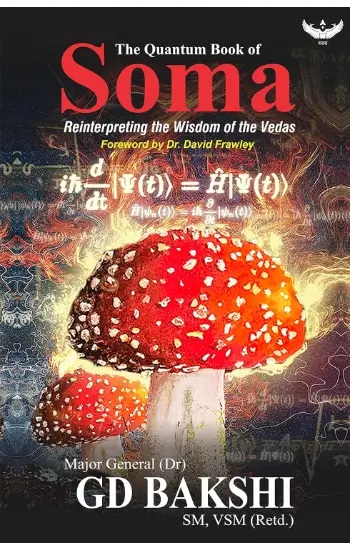
1. The Quantum Book of Soma: Reinterpreting the Wisdom of the Vedas :-
The entire 9th Mandala of the Rig Veda is devoted to this magical Soma. Soma, however, is like the Beeja mantras (Aum, Hum, Sreem etc) of the Vedas. It was a meta-concept of extraordinary elegance and beauty. It encompassed a whole spectrum or range of meanings in that one word. In this book, the author examines in detail the Botanical aspect of Soma as a psychotropic plant; studies the biological aspect of Soma as an endogenous elixir—which he personally experienced in meditation; examines the Soma of Senses—of sight, sound, touch, taste and smell—and the Soma of Action as defined in the Geeta. The highlight of this book is the Quantum Mechanical approach to understanding the Atman and the act of seeing that generates this cosmos. This book analyses the Vedic Mahavakyas in the light of latest discoveries in Quantum Physics and neuro-biology; and the correspondences are simply amazing and revelatory.
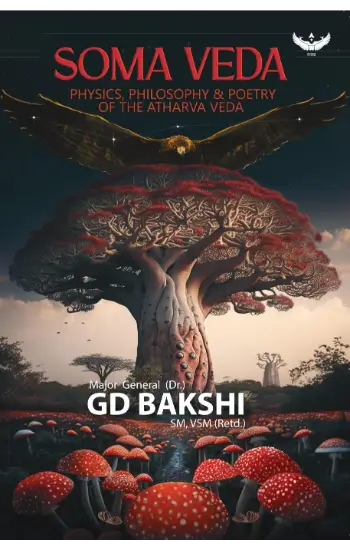
2. Soma Veda: Physics, Philosophy & Poetry of the Atharva Veda :-
In the year 2000, Major General (Dr.) G.D. Bakshi, SM, VSM (Retd.), was posted as the Commander of 9 Sector Rashtriya Rifles, for directing intensive Counter-Terrorist Operations in the rugged Himalayan region of Kishtwar. He had to carry out many heliborne operations in the remote Marwah-Dachin forest through which flowed the ancient Marud Vridha river, a river that finds mention in the Nadi-Sukta of the Rig Veda. Coincidentally, the author was then engaged in a personal study of the Atharva Veda to unravel the secret of two most mystic plants—Soma and the Ashwata tree (Kalpa vriksha). He was astonished to learn that the Pippalad Shakha of the Atharva Veda had been composed here by the Atharvan and Angirasa rishis of the forests.
This impelled him to deepen his study of the most mystic of the four Vedas, which is also called as the Brahma Veda and as Soma Veda. It deals with the science of Brahman and avers that consciousness itself is Brahman (Pragyanam Brahma). It outlines the amazing hologramic relationship between Brahman and Atman (individual soul) and declares them as one—Ayam Atma Brahma. The Atharva Veda spells out the Physics of the Vedas as Agni-Somatmakam Jagat. The Cosmos is composed of the antagonistic yet complimentary forces of Agni (Expansion-Explosion) and Soma (Gravitation-Attraction). Like Yin-Yang, this forms the very basis of Vedic physics. Agni is the primary deity of the Vedas. It was the miracle of fire that put man on top of the food chain in this planet. The ancient rishis were sages of the forest and their knowledge of psychotropic and medicinal plants was phenomenal. The Atharva Veda foreshadows the Tantras and talks of Tantu-tatam—the grid of energies, which, like the threads of a necklace, tie the infinity of things around us on a single strand of unity.
Read Soma Veda for some amazing insights into the Vedic science of Brahman and the Vedic “Mathematics of Beauty.” The book also discusses Madhu Vidya—the Vedic science of depth ecology. The book’s value is enhanced by leading scientist Padma Shri Dr. Subhash Kak’s invaluable foreword for it.

1. The Quantum Book of Soma: Reinterpreting the Wisdom of the Vedas :-
The entire 9th Mandala of the Rig Veda is devoted to this magical Soma. Soma, however, is like the Beeja mantras (Aum, Hum, Sreem etc) of the Vedas. It was a meta-concept of extraordinary elegance and beauty. It encompassed a whole spectrum or range of meanings in that one word. In this book, the author examines in detail the Botanical aspect of Soma as a psychotropic plant; studies the biological aspect of Soma as an endogenous elixir—which he personally experienced in meditation; examines the Soma of Senses—of sight, sound, touch, taste and smell—and the Soma of Action as defined in the Geeta. The highlight of this book is the Quantum Mechanical approach to understanding the Atman and the act of seeing that generates this cosmos. This book analyses the Vedic Mahavakyas in the light of latest discoveries in Quantum Physics and neuro-biology; and the correspondences are simply amazing and revelatory.
2. Soma Veda: Physics, Philosophy & Poetry of the Atharva Veda :-
In the year 2000, Major General (Dr.) G.D. Bakshi, SM, VSM (Retd.), was posted as the Commander of 9 Sector Rashtriya Rifles, for directing intensive Counter-Terrorist Operations in the rugged Himalayan region of Kishtwar. He had to carry out many heliborne operations in the remote Marwah-Dachin forest through which flowed the ancient Marud Vridha river, a river that finds mention in the Nadi-Sukta of the Rig Veda. Coincidentally, the author was then engaged in a personal study of the Atharva Veda to unravel the secret of two most mystic plants—Soma and the Ashwata tree (Kalpa vriksha). He was astonished to learn that the Pippalad Shakha of the Atharva Veda had been composed here by the Atharvan and Angirasa rishis of the forests.
This impelled him to deepen his study of the most mystic of the four Vedas, which is also called as the Brahma Veda and as Soma Veda. It deals with the science of Brahman and avers that consciousness itself is Brahman (Pragyanam Brahma). It outlines the amazing hologramic relationship between Brahman and Atman (individual soul) and declares them as one—Ayam Atma Brahma. The Atharva Veda spells out the Physics of the Vedas as Agni-Somatmakam Jagat. The Cosmos is composed of the antagonistic yet complimentary forces of Agni (Expansion-Explosion) and Soma (Gravitation-Attraction). Like Yin-Yang, this forms the very basis of Vedic physics. Agni is the primary deity of the Vedas. It was the miracle of fire that put man on top of the food chain in this planet. The ancient rishis were sages of the forest and their knowledge of psychotropic and medicinal plants was phenomenal. The Atharva Veda foreshadows the Tantras and talks of Tantu-tatam—the grid of energies, which, like the threads of a necklace, tie the infinity of things around us on a single strand of unity.
Read Soma Veda for some amazing insights into the Vedic science of Brahman and the Vedic “Mathematics of Beauty.” The book also discusses Madhu Vidya—the Vedic science of depth ecology. The book’s value is enhanced by leading scientist Padma Shri Dr. Subhash Kak’s invaluable foreword for it.
About Author
He is a prolific writer—on matters military and non-military—and has published 45 books and over 400 papers in many prestigious research journals. His articles have also been published in various national newspapers. He taught at the Indian Military Academy at Dehradun, and at the Prestigious Defence Services Staff College at Wellington for three years each. He taught at the National Defense College at New Delhi for two years and retired from this prestigious assignment in June 2008. He holds a Masters degree in Defence Science and an M. Phil. in Strategic Studies from the University of Madras. He later completed his Ph.D. from the same University on “Limited Wars in South Asia.”
Post his retirement, he was a Senior Fellow at the Centre for Strategic Studies and Simulations at the USI and later served as Deputy Director Research at the Vivekananda International Foundation. He is currently the Editor of Indian Military Review. He was Senior Security Advisor (Consultant) to Reliance Industries Limited for five years. His major books include Afghanistan-the First Fault line War, War in the 21st Century, The Indian Art Of War, The Paradox of Pakistan, The Rise of Indian Military Power: Evolution of an Indian Strategic Culture and Limited Wars in South Asia. He has also written many books on Indian Philosophy—in both Hindi and English. He appears regularly on major TV News Channels as an expert on the subjects of terrorism and national security. He lectures frequently at the Army War College, the College of Defense Management, the College of Materials Management, The National Defence Academy and the National Police Academy and also at the IAS Academy Mussorie. He has been featured in innumerable documentaries and talk shows on television on issues of National Security. He is an acknowledged thought leader in this domain. He comes from a military family and his elder brother Capt. S.R. Bakshi was killed in action in the 1965 War. The road in Jabalpur (where their ancestral house is located) is named after his brother.
Reviews
There are no reviews yet.

Reviews
There are no reviews yet.