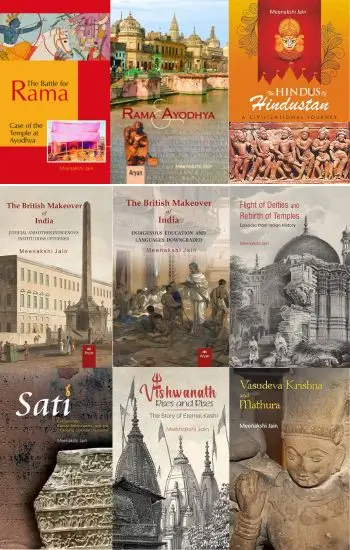
Meenakshi Jain (Set of 9 Books) : THE BRITISH MAKEOVER OF INDIA: Judicial and Other Indigenous Institutions Upturned | THE BRITISH MAKEOVER OF INDIA: Indigenous Education and Languages Downgraded | Vishwanath Rises and Rises | Rama & Ayodhya | Flight Of Deities And Rebirth Of Temples | Vasudeva Krishna And Mathura | Sati | The Hindus of Hindustan | The Battle For Rama
Publisher:
| Author:
| Language:
| Format:
Publisher:
Author:
Language:
Format:
₹8,155 Original price was: ₹8,155.₹6,931Current price is: ₹6,931.
In stock
Ships within:
In stock
ISBN:
Page Extent:
Collection of 9 books authored by Meenakshi Jain:
- Vishwanath Rises and Rises : Kashi, the City of Light, was the embodiment of Indian civilization for millennia. Archaeological mounds at Rajghat Plateau, on the northern outskirts of the city, represented the ancient settlement of Kashi. Its three major settlements, Varanasi, Sarnath, and Aktha, all had “a religious nature.” The first reference to Kashi was in the Paippalada recension of the Atharva Veda (V.22.14). The grammarian Panini mentioned Varanasi as the capital of Kashi janapada, and its citizens as varanaseya.Varanasi was first attacked in 1013 CE, by the Ghaznavid forces, under Ahmed Nialtagin. The cumulative effect of the subsequent centuries of assault was the complete obliteration of Banaras of the Puranic mahatmyas. The Krittivasa, Omkara, Mahadeva, Madhyameshvara, Visveshvara, Bindu Madhava, Kaal Bhairava, and countless other temples were all razed. In many cases, mosques were built with “calculated insolence” in their place, and the sites were forever closed to Hindus. But despite the difficult centuries, the construction of temples in Kashi did not cease, no matter how modest the structure might be.The great Vishvanath temple was destroyed no less than three times during those centuries. It was said that in 1194 CE, when first attacked by Aibak, and on each subsequent occasion, Brahmins hid the jyotirlinga in the Jnanavapi, the well of knowledge. Queen Razia, during her short turbulent reign, appropriated the site of the temple and had a mosque constructed there. The temple was subsequently rebuilt at another location, where too it was ravaged.Despite the repeated onslaughts, Banaras retained its standing as a centre of Hindu religious and intellectual activity.
- Rama & Ayodhya : This work briefly examines the antiquity of the Rama Katha and spread of the Rama cult over the Indian subcontinent in the context of claims of Left academics on its late popularity. Its main focus is the conflict at Ayodhya over the Ramjanmabhumi temple allegedly destroyed by the Mughal Emperor, Babar, in 1528. It examines the accounts of foreign travelers in the seventeenth and eighteenth centuries, and eighteenth centuries, and British administrator-scholars in the nineteenth and early twentieth centuries which testify to Ayodhya’s continuing importance as a pilgrimage centre associated with Rama’s birthplace. The extended litigation over the Ramajanmabhumi/ Babri Masjid in colonial times further attests to the persistence of the claims to the Janmabhumi.From the late 1980s, Left historians have been in the forefront of the campaign against the Rama temple. They have argued that Rama worship was an eighteenth nineteenth century phenomenon and the present day Ayodhya acquired its standing and identity only in the fifth century AD, during the rule of the imperial Guptas. According to Left academics, the identification of the Ramjanmabhumi in Ayodha was a matter of faith, not of historical evidence. They also rejected any possibility of the Babri Masjid being built on the site of the Janmabhumi temple.Excavations by the Archaeological Survey of India (ASI) proved the inaccuracy of these assertions. And finally, the judgment of the Allahabad High Court (Lucknow Bench) marked adecisive moment in the dispute over the Janmabhumi. The writings of Life academics, the findings of the ASI, the extended arguments in the Allahabad High Court and its eventual verdict-all from the subject of this study.
- THE BRITISH MAKEOVER OF INDIA: Judicial and Other Indigenous Institutions Upturned :- Early officials of the East India Company were surprised to discover that indigenous institutions of judicial redress had survived in a surprisingly good state during the centuries of “Tartar” rule. They noted that those institutions had largely remained beyond the purview of the medieval state, and had well served the needs of the populace. Subsequently, Company-men observed the functioning of indigenous judicial institutions in the areas under their control and cautioned against any transplantation from Britain.The eighteenth-century reverence for indigenous institutions was overturned in the mid-nineteenth century when a marked change in the British attitude became perceptible. The earlier appreciation gave way to censure. The transformation could be attributed to mounting self-confidence following a series of military successes in India, and triumph over Napoleonic France by 1815.
Among other factors that turned the tide against India was the advent of the Scientific Revolution. As a result, a racist element entered the British perception of India. A view gained currency that human progress was closely linked to the biological traits of people. The shape of the skull determined the size of the brain, and hence, the degree of human intelligence. Charles Darwin’s Origin of Species (1859) was used to justify Europe’s triumph in Africa and Asia; it was the natural dominance of superior white men over inferior races.
As the notion of race increasingly gained currency, there was a noticeable decline in the admiration for Indian culture. India began to be seen as a land of the past that needed to be reformed. The policy of non-interference with Indian traditions, a British byword in the eighteenth century, was abandoned in favour of change through the initiation of British institutions and values.
- Flight Of Deities And Rebirth Of Temples : This work examines the medieval response to temple destruction and image desecration. While temples were destroyed on a considerable scale also noteworthy were the repeated endeavours to reconstruct them.
- Vasudeva Krishna And Mathura : This work examines the antiquity of image worship in India. Its main focus is the Bhagavata religion that evolved around Vasudeva Krishna of the Vrishni clan. At Mathura, several noteworthy archaeological finds dated to the early Common Era were recovered from the site of Katra Keshavadeva. In the medieval period, Katra Keshavadeva was subjected to repeated devastation, beginning with that by Mahmud Ghaznavi in 1071 CE. However, within a century a temple dedicated to Vishnu was built at Katra Keshavadeva. Thereafter, the story of destruction followed by construction was repeated over and over again.In the early 17th century, the Keshavadeva temple was rebuilt by Bir Singh Deo Bundela. In 1670, the Mughal emperor, Aurangzeb ordered its destruction. An Idgah was built at the site. Later developments at Katra Keshavadeva were recorded in the judicial records of colonial India. In 1815, Katra Keshavadeva was sold by auction to Raja Patnimal of Banaras.On 8th February 1944, the heirs of Raja Patnimal sold Katra Keshavadeva to Seth Jugal Kishore Birla, who created a trust for the construction of a temple for Shree Krishna. In a surprising development, on 12th October 1968, approximately two bighas of Katra Keshavadeva were handed over to Trust Masjid Idgah.Many documents pertaining to events at Katra Keshavadeva after 1815 are perhaps being presented to the general reader for the first time. The documents attest to the dogged Hindu commitment to the site.
- Sati : This is not a work on sati per se. Its primary focus is the colonial debate on sati, particularly the role of Evangelicals and Baptist missionaries. It argues that sati was an exceptional act, performed by a miniscule number of Hindu widows over the centuries. It occurrence was, however, exaggerated in the nineteenth century by Evangelicals and Baptist missionaries eager to Anglicize and Christianize India.
- The Hindus of Hindustan :Notwithstanding the views of a section of historians and literati, spiritual, religious, and cultural continuity in India goes back many millennia. Identification with, and adoration of, the land was expressed in the sixty-three verses long Prithvi Sukta of the Atharva Veda, described as the first “national song” in the world. Veneration of the land remained a recurrent theme in sacred literature.Kautilya, in the Arthasastra, articulated the ideal of political unification, when he said that from the Himalayas to the seas, the land should have one ruler. That ideal was accompanied by a consciousness of cultural union. Evidence of continuity of religious beliefs and motifs could be traced to the late Upper Palaeolithic (c. 9000-8000) site of Baghor I (Sidhi district, Madhya Pradesh), to the celebrated Indus Valley Civilization, and well thereafter. Rulers of foreign origin, who ruled over parts of the north-western regions for significant periods, wholly immersed themselves in the spiritual traditions of the land. Ancient lawgivers facilitated the assimilation of foreign groups within the capacious embrace of Indian civilization. Things took a dramatically new turn with the advent of a new group of invaders in the eighth century CE. The book highlights the underlying features of Indian civilization, that were manifest from its founding moments, and that remained unchanged over the millennia.
- The Battle For Rama : For over two decades, a handful of Left historians have strenuously endeavored to stymie the Ramjanmabhumi movement. From questioning the antiquity of Rama worship and the identity of ancient Ayodhya, they have also challenged the widely held belief that Babri Masjid was built on the site of the Janmabhumi temple. Scholars have, however, traced the antiquity of the Rama Katha as far back as the sixth-fifth century BCE, when ancient ballads (Akhyanas) transmitted Rama’s story orally. Valmiki?s Ramayana itself has been dated to the fourth-third century BCE. Over the centuries, Rama’s story has been re-told in many vernaculars of the country. Rama is the exemplar of moral values for Hindu society and epitomizes its aspirations of Artha, kama, and above all, dharma. The proceedings of the Allahabad High Court have exposed the vulnerabilities of Left historians. They could proffer no evidence of continued Muslim presence at Babri Masjid, while the unwavering commitment of Hindu devotees to the site has been attested by several sources. Babri Masjid was not mentioned in the revenue records of the Nawabi and British periods, nor was any Waqf ever created for its upkeep. No Muslim filed an FIR or complained of dispossession or obstruction in his alleged use of the Masjid when the image of Sri Rama was placed under the central dome on 23rd December 1949. The Sunni Central Waqf Board entered litigation on 18th December 1961, just five days before the twelfth anniversary of the placement of the image in the Masjid, on which date any claim would have become time-barred. The Board did not file a suit for a possession; instead, it sought a declaration on the status of the property. Further, excavations of the ASI revealed uninterrupted occupation of the site since the 13th-century BCE. They also exposed remnants of the temple on which Babri Masjid was erected. The assertions of Left historians on Babri Masjid have all been found to be erroneous, yet there has been no public retraction. Indeed, they continue to peddle their discredited theories despite the mounting evidence against them.

Collection of 9 books authored by Meenakshi Jain:
- Vishwanath Rises and Rises : Kashi, the City of Light, was the embodiment of Indian civilization for millennia. Archaeological mounds at Rajghat Plateau, on the northern outskirts of the city, represented the ancient settlement of Kashi. Its three major settlements, Varanasi, Sarnath, and Aktha, all had “a religious nature.” The first reference to Kashi was in the Paippalada recension of the Atharva Veda (V.22.14). The grammarian Panini mentioned Varanasi as the capital of Kashi janapada, and its citizens as varanaseya.Varanasi was first attacked in 1013 CE, by the Ghaznavid forces, under Ahmed Nialtagin. The cumulative effect of the subsequent centuries of assault was the complete obliteration of Banaras of the Puranic mahatmyas. The Krittivasa, Omkara, Mahadeva, Madhyameshvara, Visveshvara, Bindu Madhava, Kaal Bhairava, and countless other temples were all razed. In many cases, mosques were built with “calculated insolence” in their place, and the sites were forever closed to Hindus. But despite the difficult centuries, the construction of temples in Kashi did not cease, no matter how modest the structure might be.The great Vishvanath temple was destroyed no less than three times during those centuries. It was said that in 1194 CE, when first attacked by Aibak, and on each subsequent occasion, Brahmins hid the jyotirlinga in the Jnanavapi, the well of knowledge. Queen Razia, during her short turbulent reign, appropriated the site of the temple and had a mosque constructed there. The temple was subsequently rebuilt at another location, where too it was ravaged.Despite the repeated onslaughts, Banaras retained its standing as a centre of Hindu religious and intellectual activity.
- Rama & Ayodhya : This work briefly examines the antiquity of the Rama Katha and spread of the Rama cult over the Indian subcontinent in the context of claims of Left academics on its late popularity. Its main focus is the conflict at Ayodhya over the Ramjanmabhumi temple allegedly destroyed by the Mughal Emperor, Babar, in 1528. It examines the accounts of foreign travelers in the seventeenth and eighteenth centuries, and eighteenth centuries, and British administrator-scholars in the nineteenth and early twentieth centuries which testify to Ayodhya’s continuing importance as a pilgrimage centre associated with Rama’s birthplace. The extended litigation over the Ramajanmabhumi/ Babri Masjid in colonial times further attests to the persistence of the claims to the Janmabhumi.From the late 1980s, Left historians have been in the forefront of the campaign against the Rama temple. They have argued that Rama worship was an eighteenth nineteenth century phenomenon and the present day Ayodhya acquired its standing and identity only in the fifth century AD, during the rule of the imperial Guptas. According to Left academics, the identification of the Ramjanmabhumi in Ayodha was a matter of faith, not of historical evidence. They also rejected any possibility of the Babri Masjid being built on the site of the Janmabhumi temple.Excavations by the Archaeological Survey of India (ASI) proved the inaccuracy of these assertions. And finally, the judgment of the Allahabad High Court (Lucknow Bench) marked adecisive moment in the dispute over the Janmabhumi. The writings of Life academics, the findings of the ASI, the extended arguments in the Allahabad High Court and its eventual verdict-all from the subject of this study.
- THE BRITISH MAKEOVER OF INDIA: Judicial and Other Indigenous Institutions Upturned :- Early officials of the East India Company were surprised to discover that indigenous institutions of judicial redress had survived in a surprisingly good state during the centuries of “Tartar” rule. They noted that those institutions had largely remained beyond the purview of the medieval state, and had well served the needs of the populace. Subsequently, Company-men observed the functioning of indigenous judicial institutions in the areas under their control and cautioned against any transplantation from Britain.The eighteenth-century reverence for indigenous institutions was overturned in the mid-nineteenth century when a marked change in the British attitude became perceptible. The earlier appreciation gave way to censure. The transformation could be attributed to mounting self-confidence following a series of military successes in India, and triumph over Napoleonic France by 1815.
Among other factors that turned the tide against India was the advent of the Scientific Revolution. As a result, a racist element entered the British perception of India. A view gained currency that human progress was closely linked to the biological traits of people. The shape of the skull determined the size of the brain, and hence, the degree of human intelligence. Charles Darwin’s Origin of Species (1859) was used to justify Europe’s triumph in Africa and Asia; it was the natural dominance of superior white men over inferior races.
As the notion of race increasingly gained currency, there was a noticeable decline in the admiration for Indian culture. India began to be seen as a land of the past that needed to be reformed. The policy of non-interference with Indian traditions, a British byword in the eighteenth century, was abandoned in favour of change through the initiation of British institutions and values.
- Flight Of Deities And Rebirth Of Temples : This work examines the medieval response to temple destruction and image desecration. While temples were destroyed on a considerable scale also noteworthy were the repeated endeavours to reconstruct them.
- Vasudeva Krishna And Mathura : This work examines the antiquity of image worship in India. Its main focus is the Bhagavata religion that evolved around Vasudeva Krishna of the Vrishni clan. At Mathura, several noteworthy archaeological finds dated to the early Common Era were recovered from the site of Katra Keshavadeva. In the medieval period, Katra Keshavadeva was subjected to repeated devastation, beginning with that by Mahmud Ghaznavi in 1071 CE. However, within a century a temple dedicated to Vishnu was built at Katra Keshavadeva. Thereafter, the story of destruction followed by construction was repeated over and over again.In the early 17th century, the Keshavadeva temple was rebuilt by Bir Singh Deo Bundela. In 1670, the Mughal emperor, Aurangzeb ordered its destruction. An Idgah was built at the site. Later developments at Katra Keshavadeva were recorded in the judicial records of colonial India. In 1815, Katra Keshavadeva was sold by auction to Raja Patnimal of Banaras.On 8th February 1944, the heirs of Raja Patnimal sold Katra Keshavadeva to Seth Jugal Kishore Birla, who created a trust for the construction of a temple for Shree Krishna. In a surprising development, on 12th October 1968, approximately two bighas of Katra Keshavadeva were handed over to Trust Masjid Idgah.Many documents pertaining to events at Katra Keshavadeva after 1815 are perhaps being presented to the general reader for the first time. The documents attest to the dogged Hindu commitment to the site.
- Sati : This is not a work on sati per se. Its primary focus is the colonial debate on sati, particularly the role of Evangelicals and Baptist missionaries. It argues that sati was an exceptional act, performed by a miniscule number of Hindu widows over the centuries. It occurrence was, however, exaggerated in the nineteenth century by Evangelicals and Baptist missionaries eager to Anglicize and Christianize India.
- The Hindus of Hindustan :Notwithstanding the views of a section of historians and literati, spiritual, religious, and cultural continuity in India goes back many millennia. Identification with, and adoration of, the land was expressed in the sixty-three verses long Prithvi Sukta of the Atharva Veda, described as the first “national song” in the world. Veneration of the land remained a recurrent theme in sacred literature.Kautilya, in the Arthasastra, articulated the ideal of political unification, when he said that from the Himalayas to the seas, the land should have one ruler. That ideal was accompanied by a consciousness of cultural union. Evidence of continuity of religious beliefs and motifs could be traced to the late Upper Palaeolithic (c. 9000-8000) site of Baghor I (Sidhi district, Madhya Pradesh), to the celebrated Indus Valley Civilization, and well thereafter. Rulers of foreign origin, who ruled over parts of the north-western regions for significant periods, wholly immersed themselves in the spiritual traditions of the land. Ancient lawgivers facilitated the assimilation of foreign groups within the capacious embrace of Indian civilization. Things took a dramatically new turn with the advent of a new group of invaders in the eighth century CE. The book highlights the underlying features of Indian civilization, that were manifest from its founding moments, and that remained unchanged over the millennia.
- The Battle For Rama : For over two decades, a handful of Left historians have strenuously endeavored to stymie the Ramjanmabhumi movement. From questioning the antiquity of Rama worship and the identity of ancient Ayodhya, they have also challenged the widely held belief that Babri Masjid was built on the site of the Janmabhumi temple. Scholars have, however, traced the antiquity of the Rama Katha as far back as the sixth-fifth century BCE, when ancient ballads (Akhyanas) transmitted Rama’s story orally. Valmiki?s Ramayana itself has been dated to the fourth-third century BCE. Over the centuries, Rama’s story has been re-told in many vernaculars of the country. Rama is the exemplar of moral values for Hindu society and epitomizes its aspirations of Artha, kama, and above all, dharma. The proceedings of the Allahabad High Court have exposed the vulnerabilities of Left historians. They could proffer no evidence of continued Muslim presence at Babri Masjid, while the unwavering commitment of Hindu devotees to the site has been attested by several sources. Babri Masjid was not mentioned in the revenue records of the Nawabi and British periods, nor was any Waqf ever created for its upkeep. No Muslim filed an FIR or complained of dispossession or obstruction in his alleged use of the Masjid when the image of Sri Rama was placed under the central dome on 23rd December 1949. The Sunni Central Waqf Board entered litigation on 18th December 1961, just five days before the twelfth anniversary of the placement of the image in the Masjid, on which date any claim would have become time-barred. The Board did not file a suit for a possession; instead, it sought a declaration on the status of the property. Further, excavations of the ASI revealed uninterrupted occupation of the site since the 13th-century BCE. They also exposed remnants of the temple on which Babri Masjid was erected. The assertions of Left historians on Babri Masjid have all been found to be erroneous, yet there has been no public retraction. Indeed, they continue to peddle their discredited theories despite the mounting evidence against them.
About Author
Reviews
There are no reviews yet.

Reviews
There are no reviews yet.