GETTING STARTED WITH DATA SCIENCE: MAKING SENSE OF DATA WITH ANALYTICS Original price was: ₹990.Current price is: ₹841.

Save: 15%

Back to products
GENERATIVE ARTIFICIAL INTELLIGENCE WHAT EVERYONE NEEDS TO KNOW® Original price was: ₹995.Current price is: ₹845.

Save: 15%

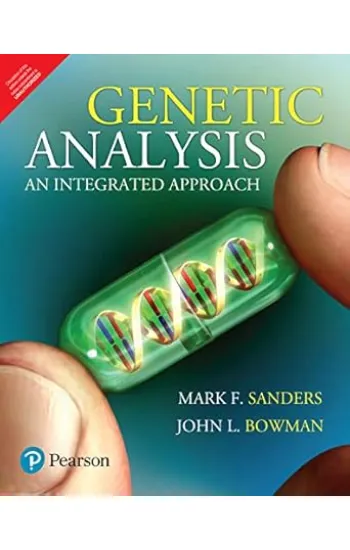
GENETIC ANALYSIS: AN INTEGRATED APPROACH

Publisher:
PEARSON INDIA
| Author:
SANDERS, BOWMAN
| Language:
English
| Format:
Paperback
Publisher:
PEARSON INDIA
Author:
SANDERS, BOWMAN
Language:
English
Format:
Paperback

Original price was: ₹979.Current price is: ₹832.

Save: 15%

In stock

Ships within:
7-10 Days

In stock

Book Type

Discount
Genre

Academics

ISBN:
SKU 9789332578555 Category
Category:
Page Extent:
872

Informed by many years of genetics teaching and research experience, authors Mark Sanders and John Bowman use an integrative approach that helps contextualize three core challenges of learning genetics: solving problems, understanding evolution and understanding the connection between traditional genetics models and more modern approaches. An integrative problem-solving approach presents a consistent and effective strategy for students to work through genetics problems.

Genetic Analysis sections guide students with a unique, three step approach that trains them to Evaluate, Deduce and then Solve problems. Each Genetic Analysis is presented in a clear, two-column format that helps students see the Solution Strategy in one column and its corresponding execution in the Solution Step. Genetic Analysis sections are integrated throughout each chapter, right after discussions of important content. Each one includes helpful Tips to highlight critical steps and Pitfalls to avoid, as well as references to similar problems at the end of the chapter for additional practice.

End-of-Chapter Problems are divided into separate sections labeled Chapter Concepts and Application and Integration. The book offers a broad range of question types and level of difficulty. Answers to even-numbered problems appear in the Appendix.

The Accompanying Student Solutions Manual and Study Guide provides additional worked problems along with tips for solving problems. It also presents solutions to all of the textbook problems in a consistent Evaluate, Deduce and Solve format to complement the approach modeled in the Genetic Analysis examples.

Reviews

There are no reviews yet.

Be the first to review “GENETIC ANALYSIS: AN INTEGRATED APPROACH”

Your email address will not be published. Required fields are marked *

Description

Informed by many years of genetics teaching and research experience, authors Mark Sanders and John Bowman use an integrative approach that helps contextualize three core challenges of learning genetics: solving problems, understanding evolution and understanding the connection between traditional genetics models and more modern approaches. An integrative problem-solving approach presents a consistent and effective strategy for students to work through genetics problems.

Genetic Analysis sections guide students with a unique, three step approach that trains them to Evaluate, Deduce and then Solve problems. Each Genetic Analysis is presented in a clear, two-column format that helps students see the Solution Strategy in one column and its corresponding execution in the Solution Step. Genetic Analysis sections are integrated throughout each chapter, right after discussions of important content. Each one includes helpful Tips to highlight critical steps and Pitfalls to avoid, as well as references to similar problems at the end of the chapter for additional practice.

End-of-Chapter Problems are divided into separate sections labeled Chapter Concepts and Application and Integration. The book offers a broad range of question types and level of difficulty. Answers to even-numbered problems appear in the Appendix.

The Accompanying Student Solutions Manual and Study Guide provides additional worked problems along with tips for solving problems. It also presents solutions to all of the textbook problems in a consistent Evaluate, Deduce and Solve format to complement the approach modeled in the Genetic Analysis examples.

About Author

Mark F. Sanders has been a faculty member in the Department of Molecular and Cellular Biology at the University of California, Davis for 27 years. In that time, he has taught more than 120 genetics courses to more than 30, 000 undergraduate students. Specializing in teaching the genetics course for which this book is written, Dr. Sanders also teaches a genetics laboratory course, an advanced human genetics course for biology majors and a human heredity course for non-science majors. His teaching experience also includes introductory biology and courses in population genetics and evolution.

Dr. Sanders received his Bachelors degree in Anthropology from San Francisco State University and his Master’s and Ph. D. degrees in Biological Anthropology from the University of California, Los Angeles. Following graduation, he spent four years at the University of California, Berkeley as a post-doctoral researcher studying inherited susceptibility to human breast and ovarian cancer. At UC Berkeley he also taught his first genetics courses. Since coming to the University of California, Davis, Dr. Sanders has maintained a full-time teaching schedule and promotes academic achievement by undergraduate students in numerous ways, including as an active student advisor, through his on-going role as the director of a long-standing undergraduate student program and by past service as the Associate Dean for Undergraduate Academic Programs in the College of Biological Sciences.

John L. Bowman is a Professor in the School of Biological Sciences at Monash University in Melbourne, Australia and an Adjunct Professor in the Department of Plant Biology at the University of California, Davis in the US. He received a B. S. In Biochemistry at the University of Illinois at Urbana-Champaign, Illinois in 1986 and a Ph. D. In Biology from the California Institute of Technology in Pasadena, California. His Ph. D. research focused on how the identities floral organs are specified in Arabidopsis (described in Chapter 20). He conducted postdoctoral research at Monash University on the regulation of floral development. From 1996-2006 his laboratory at UC Davis focused on the developmental genetics of plant development, focusing on how leaves are patterned. From 2006-2011 he was a Federation Fellow at Monash University where his laboratory is studying land plant evolution using a developmental genetics approach. At UC Davis he taught genetics, 'from Mendel to cancer', to undergraduate students and continues to teach in genetics courses at Monash University.

Reviews

There are no reviews yet.

Be the first to review “GENETIC ANALYSIS: AN INTEGRATED APPROACH”

Your email address will not be published. Required fields are marked *

[wt-related-products product_id="test001"]

RELATED PRODUCTS

RECENTLY VIEWED