Combo Set Of 2 R Nagaswamy Books – Brhadisvara Temple | Vedic Roots of Hindu Iconography
Publisher:
| Author:
| Language:
| Format:
Publisher:
Author:
Language:
Format:
₹5,500 Original price was: ₹5,500.₹3,575Current price is: ₹3,575.
Out of stock
Ships within:
Out of stock
ISBN:
Page Extent:
1.Brhadisvara Temple :-
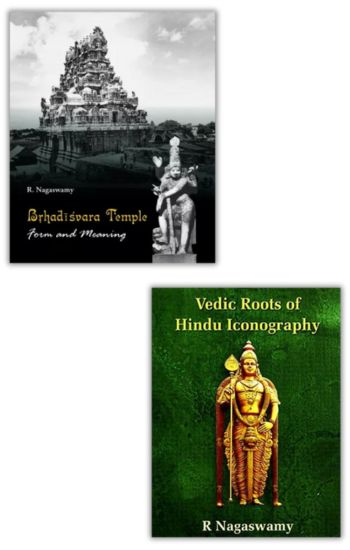
The Great Temple at Tanjavur is a visual representation of Cosmic power on earth that remains, according to the pious wish of the builder, so long as the sun and moon lasts. This metaphysical mountain is called the great meru- Mahameru, which forms the basic concept of the Brhadisvara temple of Tanjore. Meru, the mythical mountain is said to be a golden mountain. True to its nature, Rajaraja covered the superstructure of this temple with gold, that made this loftiest golden temple at that time. The images one sees on the upper tiers represented with bow and arrow in their arms are the innumerable Rudras called Sata-rudras, who are said to move in the upper spheres and represent the sun’s rays, a representation unique to this temple. This temple also portrays the five forms of Panca Brahmans, Tatpurusa, Aghora, Sadyojata, Vamadeva and Isana, in individual sculptural forms and enshrined in the lower niches. With four sides of the sanctum provided with openings and its height exactly double its width at the base, the lofty tower fulfils all requirements of the Meru type of temple architecture. The available karanas are discussed in this volume for the first time in the light of Abhinavagupta’s commentary and also the views of modern scholars. The story is taken through the centuries and its change in meaning and ritual are brought out in this volume which points out what a Hindu temple mean when in full form and through the centuries.
2.Vedic Roots of Hindu Iconography :-
This book explores the Hindu iconography from the Vedic to recent period in time and space that would dispel many misconceptions. The first few articles deal with Agni, the fire of Vedas. The fire has two inherent powers, the consuming heat energy and illuminating-beneficial energy, which they called on one hand as Rudra and on the other Vishnu. Similarly Rudra is like the father and the benevolent energy of the same fire, insuperable, is called mother devi Parvati, the male and the female, in one and the same form as Ardhanari. Most of the important iconographic visualizations arise from such syncretic forms that are dealt with in this volume. For example the concept of Linga or Varaha, gives so many layers that are properly focused that would come as revelations. At another level some individual manifestations like Andhakasuravadha or Nataraja are rooted in Vedic understanding of darkness and light. The writings of some that there was no worship of feminine power in the Vedic age are shown as pedestrian, worthy of outright rejection. Similarly some hold that the Muruga Kartikeya is exclusive and the earliest god of the Tamil is disproved and shown here as a Sanskrit word “”Mrgya”” in Prakrit form. The origin of Rama and Krishna and their place in the chronological perspective is given in detail with epigraphical evidence and disproved some of the abysmal ignorance of some professorial claimants. Each article with references and notes is thought provoking, original and linked to the factual utterances which are absolutely necessary for those who seek proper approach to the subject.

1.Brhadisvara Temple :-
The Great Temple at Tanjavur is a visual representation of Cosmic power on earth that remains, according to the pious wish of the builder, so long as the sun and moon lasts. This metaphysical mountain is called the great meru- Mahameru, which forms the basic concept of the Brhadisvara temple of Tanjore. Meru, the mythical mountain is said to be a golden mountain. True to its nature, Rajaraja covered the superstructure of this temple with gold, that made this loftiest golden temple at that time. The images one sees on the upper tiers represented with bow and arrow in their arms are the innumerable Rudras called Sata-rudras, who are said to move in the upper spheres and represent the sun’s rays, a representation unique to this temple. This temple also portrays the five forms of Panca Brahmans, Tatpurusa, Aghora, Sadyojata, Vamadeva and Isana, in individual sculptural forms and enshrined in the lower niches. With four sides of the sanctum provided with openings and its height exactly double its width at the base, the lofty tower fulfils all requirements of the Meru type of temple architecture. The available karanas are discussed in this volume for the first time in the light of Abhinavagupta’s commentary and also the views of modern scholars. The story is taken through the centuries and its change in meaning and ritual are brought out in this volume which points out what a Hindu temple mean when in full form and through the centuries.
2.Vedic Roots of Hindu Iconography :-
This book explores the Hindu iconography from the Vedic to recent period in time and space that would dispel many misconceptions. The first few articles deal with Agni, the fire of Vedas. The fire has two inherent powers, the consuming heat energy and illuminating-beneficial energy, which they called on one hand as Rudra and on the other Vishnu. Similarly Rudra is like the father and the benevolent energy of the same fire, insuperable, is called mother devi Parvati, the male and the female, in one and the same form as Ardhanari. Most of the important iconographic visualizations arise from such syncretic forms that are dealt with in this volume. For example the concept of Linga or Varaha, gives so many layers that are properly focused that would come as revelations. At another level some individual manifestations like Andhakasuravadha or Nataraja are rooted in Vedic understanding of darkness and light. The writings of some that there was no worship of feminine power in the Vedic age are shown as pedestrian, worthy of outright rejection. Similarly some hold that the Muruga Kartikeya is exclusive and the earliest god of the Tamil is disproved and shown here as a Sanskrit word “”Mrgya”” in Prakrit form. The origin of Rama and Krishna and their place in the chronological perspective is given in detail with epigraphical evidence and disproved some of the abysmal ignorance of some professorial claimants. Each article with references and notes is thought provoking, original and linked to the factual utterances which are absolutely necessary for those who seek proper approach to the subject.
About Author
Reviews
There are no reviews yet.

Reviews
There are no reviews yet.