Bangladesh: Humiliation, Carnage, Liberation, Chaos
Publisher:
| Author:
| Language:
| Format:
Publisher:
Author:
Language:
Format:
₹899 Original price was: ₹899.₹809Current price is: ₹809.
In stock
Ships within:
In stock
ISBN:
Page Extent:
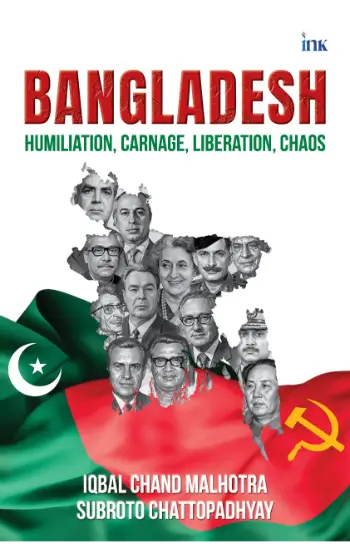
The roots of the conflict between East and West Pakistan go back to the traumatic partition of the subcontinent in 1947. Pakistan was united by religion but divided by language and culture—fault lines that soon metastasized into repeated humiliations and injustices. As protests erupted, the Pakistan Army unleashed a brutal campaign to silence dissent: three million people were killed, over 200,000 women were subjected to sexual violence, and ten million refugees fled to India, all for demanding autonomy.
The silence of the international community was deafening. The US and China, openly tilting towards Pakistan, did nothing to halt the unfolding genocide. The subcontinent had become the epicentre of a superpower contest.
India stood isolated.
Impoverished and destabilized by left-wing insurgency yet morally steadfast, Indira Gandhi’s India—working in close coordination with Tajuddin Ahmad, Bangladesh’s first PM, and the resolute Mukti Bahini—waged a covert struggle for nine months. This culminated in a swift thirteen-day military campaign that broke the Pakistan Army, resulted in the capture of 93,000 prisoners of war, and delivered Bangladesh in one of history’s fastest and most decisive liberations.
All arms of the Indian state and Bangladesh’s government-in-exile had worked in perfect unison to deliver a glorious victory, yet peace proved fragile. Chaos followed almost immediately after independence, and nearly all the central figures of the struggle were eventually assassinated in a spiral of senseless violence.
Half a century later, as the same hatreds of language, identity, and faith erupt again, the ghosts of 1971 return—not as memory, but as warning.

The roots of the conflict between East and West Pakistan go back to the traumatic partition of the subcontinent in 1947. Pakistan was united by religion but divided by language and culture—fault lines that soon metastasized into repeated humiliations and injustices. As protests erupted, the Pakistan Army unleashed a brutal campaign to silence dissent: three million people were killed, over 200,000 women were subjected to sexual violence, and ten million refugees fled to India, all for demanding autonomy.
The silence of the international community was deafening. The US and China, openly tilting towards Pakistan, did nothing to halt the unfolding genocide. The subcontinent had become the epicentre of a superpower contest.
India stood isolated.
Impoverished and destabilized by left-wing insurgency yet morally steadfast, Indira Gandhi’s India—working in close coordination with Tajuddin Ahmad, Bangladesh’s first PM, and the resolute Mukti Bahini—waged a covert struggle for nine months. This culminated in a swift thirteen-day military campaign that broke the Pakistan Army, resulted in the capture of 93,000 prisoners of war, and delivered Bangladesh in one of history’s fastest and most decisive liberations.
All arms of the Indian state and Bangladesh’s government-in-exile had worked in perfect unison to deliver a glorious victory, yet peace proved fragile. Chaos followed almost immediately after independence, and nearly all the central figures of the struggle were eventually assassinated in a spiral of senseless violence.
Half a century later, as the same hatreds of language, identity, and faith erupt again, the ghosts of 1971 return—not as memory, but as warning.
About Author
Subroto Chattopadhyay is the founder-chairman of The Peninsula Studios and an accomplished corporate leader, having served as the CEO and executive director at major companies such as PepsiCo, ITC, Saregama (HMV), and Brooke Bond. He has co-produced feature films such as The Japanese Wife by Aparna Sen and directed over 350 music videos (including Coke Studio Roots) and 140 documentaries (under Brains Trust India), focusing on preserving and promoting the history and heritage of the subcontinent. His expertise spans business strategy, content creation, and education with significant contributions to music archiving and skill development for youth. Chattopadhyay has also produced a series of podcasts on the liberation war of Bangladesh narrated by veterans who fought in the campaign. He has been a speaker at the National Defence College, New Delhi, and programmes conducted by the Indian Army.
Reviews
There are no reviews yet.

Reviews
There are no reviews yet.