Aspects of India: Essays in Honor of Edward Cameron Dimock
Aspects of India: Essays in Honor of Edward Cameron Dimock Original price was: ₹350.Current price is: ₹280.
Back to products
Assertive Religious Identities: India and Europe
Assertive Religious Identities: India and Europe Original price was: ₹995.Current price is: ₹796.

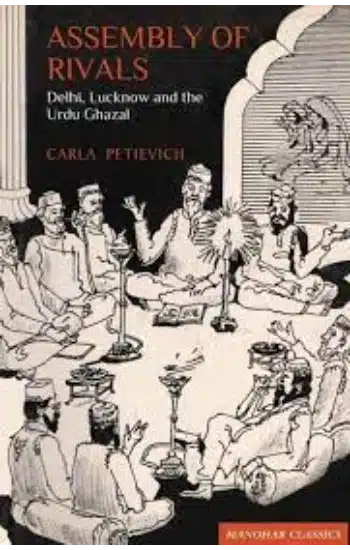
Assembly of Rivals: Delhi Lucknow and the Urdu Ghazal

Publisher:
Manohar
| Author:
Carla Petievich
| Language:
English
| Format:
Hardback
Publisher:
Manohar
Author:
Carla Petievich
Language:
English
Format:
Hardback

Original price was: ₹1,095.Current price is: ₹876.

In stock

Ships within:
7-10 Days

In stock

ISBN:
Page Extent:
225

Urdu critics have described the traditions of poetry of Delhi and Lucknow as rival ‘Schools’ and argued that their literary differences reflected differing social conditions in the two primary centers of Muslim culture in north India during eighteenth and nineteenth centuries. Assembly of Rivals challenges this Two School theory, arguing that a careful examination of Dihlavi and Lakhnavi ghazal texts does not support the distinctions drawn by critics between the two bodies of poetry, and that Delhi-Lucknow distinctions are better understood in the context of a fierce competition for cultural authority which rages between the two centers during a time of political flux. The author first traces how the Two School theory developed from impressionistic, oblique comments in Urdu’s earliest critical works by Muhammad Husain Azad and Altaf Husain Hali into a full-blown, formal classification of separate Delhi and Lucknow schools in Abdus Salam Nadvi’s Sherul Hind (1926). Next, the literary definitions of the Two School theory are challenged in a detailed comparison of verses by Dihlavi and Lakhnavi masters written in the same meter and rhyme-scheme. Finally, the Two School theory – amply refutable on literary grounds – is suggested as a discursive device linking Delhi to Mughal and Indo-Persian heritage, and Lucknow to less ‘legitimate’ aspects of Indian culture, as a means of legitimizing Indo-Muslim culture in the face of a moralizing colonial presence. This book is not merely an indepth study of literary trends in the two great centers; it also provides a glimpse of the historical and cultural traditions of the areas studied.

Reviews

There are no reviews yet.

Be the first to review “Assembly of Rivals: Delhi Lucknow and the Urdu Ghazal”

Your email address will not be published. Required fields are marked *

Description

Urdu critics have described the traditions of poetry of Delhi and Lucknow as rival ‘Schools’ and argued that their literary differences reflected differing social conditions in the two primary centers of Muslim culture in north India during eighteenth and nineteenth centuries. Assembly of Rivals challenges this Two School theory, arguing that a careful examination of Dihlavi and Lakhnavi ghazal texts does not support the distinctions drawn by critics between the two bodies of poetry, and that Delhi-Lucknow distinctions are better understood in the context of a fierce competition for cultural authority which rages between the two centers during a time of political flux. The author first traces how the Two School theory developed from impressionistic, oblique comments in Urdu’s earliest critical works by Muhammad Husain Azad and Altaf Husain Hali into a full-blown, formal classification of separate Delhi and Lucknow schools in Abdus Salam Nadvi’s Sherul Hind (1926). Next, the literary definitions of the Two School theory are challenged in a detailed comparison of verses by Dihlavi and Lakhnavi masters written in the same meter and rhyme-scheme. Finally, the Two School theory – amply refutable on literary grounds – is suggested as a discursive device linking Delhi to Mughal and Indo-Persian heritage, and Lucknow to less ‘legitimate’ aspects of Indian culture, as a means of legitimizing Indo-Muslim culture in the face of a moralizing colonial presence. This book is not merely an indepth study of literary trends in the two great centers; it also provides a glimpse of the historical and cultural traditions of the areas studied.

About Author

Reviews

There are no reviews yet.

Be the first to review “Assembly of Rivals: Delhi Lucknow and the Urdu Ghazal”

Your email address will not be published. Required fields are marked *

[wt-related-products product_id="test001"]

RELATED PRODUCTS

RECENTLY VIEWED